

Datsun history begins before the Datsun name existed and continues into the present through the legacy the brand left behind, its later absorption into Nissan’s global identity, and its brief twenty first century revival. That full history matters because Datsun was never only a badge on a few enthusiast favorites. It was one of the key names in Japan’s automotive rise, an export success story, and a brand that introduced generations of buyers to compact cars, sedans, sports cars, trucks, and performance models that were attainable, durable, and often surprisingly rewarding to drive.
The story starts in 1911, when Masujiro Hashimoto founded Kwaishinsha Motor Car Works in Tokyo. In 1914, the company produced the DAT, a name generally tied to the surnames of three principal backers: Den, Aoyama, and Takeuchi. That early car occupies an important place in Japanese automotive history because it came from a period when domestic vehicle manufacturing was still developing and local companies were trying to prove that Japan could build automobiles of its own.
The business changed form several times in its early years. In 1926, Kwaishinsha merged with Jitsuyo Jidosha Seizo Co., Ltd. to form DAT Jidosha Seizo Co., Ltd. As with many early manufacturers, the market often favored trucks and commercial vehicles more than passenger cars, so practical production needs shaped the company’s direction. Even so, the passenger-car line never disappeared from the story. It remained the seed from which the later brand identity grew.
In 1931, the company developed a smaller passenger car called Datson, commonly understood as meaning “son of DAT.” The name soon changed to Datsun, with “sun” replacing “son.” That shift gave the marque the name that would become famous around the world.
At nearly the same time, the Nissan corporate structure was taking shape. In 1933, the automobile business was reorganized under what became Nissan Motor Co., Ltd., and by 1934 the Nissan corporate name had been formalized. This is a crucial distinction in the brand’s history. Nissan became the company name, while Datsun remained the public-facing brand on many vehicles. In other words, Datsun didn’t suddenly become Nissan in one clean moment. For decades, the two names existed in different roles.
During the 1930s, passenger cars and trucks helped establish the brand’s reputation for light, practical, value-oriented transportation. World War II interrupted that development, as passenger-car production across Japan was reshaped by wartime demands. Still, the name had been established, and it would return in force after the war.
Postwar recovery was one of the most important phases in Datsun history. Nissan resumed production in the late 1940s, and Datsun passenger cars returned as Japan rebuilt its industrial capacity. In these early postwar years, the company focused on practical, affordable transportation that could meet domestic needs while also laying the groundwork for export growth.
This period mattered because it set the tone for what the brand would become internationally. The brand wasn’t built around prestige. It was built around usefulness, efficiency, and durability. Those qualities helped Datsun gain traction at home and prepared it for expansion abroad.
Datsun entered the United States in the late 1950s, and those first export efforts were foundational. The 1000 sedan and truck helped establish the brand in America, even if they were modest vehicles by later standards. They introduced buyers to the idea that a Japanese car could be affordable, reliable, and practical.
The Bluebird 310 belongs in this part of the story as well. As Datsun expanded its export footprint, the Bluebird line became an important step in proving that the company could sell compact sedans with broader appeal in global markets. The 310 helped demonstrate that Datsun could do more than sell bare-bones transportation. It could offer a small family car that was usable, efficient, and suitable for a growing international customer base.
That growing export reputation mattered because it gave Datsun the market position to broaden its lineup. By the early 1960s, the brand was no longer an unknown newcomer. It was becoming a serious player in the small-car market.
The 1960s are where Datsun’s image expanded from practical transportation to genuine enthusiast relevance. The Fairlady roadsters, including the 310 and 311 generations, gave the brand a real sports-car identity. These cars were light, rear-wheel-drive, and mechanically direct. They helped establish the idea that a Datsun could be fun as well as sensible.
At the same time, the Bluebird line continued to strengthen Datsun’s global reputation in the sedan market. That progression led naturally to the 510, which became one of the defining enthusiast sedans of its era. Introduced in the late 1960s, the 510 earned lasting respect because it combined compact size, everyday usability, and handling capability in a package ordinary buyers could actually afford.
This period is essential to a complete history because it shows that Datsun’s importance didn’t come from one single halo model. It came from a broader lineup that reached commuters, families, weekend racers, and sports-car buyers all at once.


If the 510 and the roadsters built Datsun’s enthusiast foundation, the S30-series Z made the brand globally famous. The 240Z, introduced at the end of the 1960s, brought together striking styling, six-cylinder power, everyday usability, and an attainable price. The later 260Z and 280Z carried that momentum forward.
The impact of the Z cars went well beyond sales volume. They changed global perceptions of Japanese performance cars and helped prove that a Japanese manufacturer could deliver a sports car with real style, credibility, and staying power. In the United States especially, the Z became one of the strongest symbols of Datsun’s rise.
The rest of the lineup also continued to matter during the 1970s. Sedans, pickups, and smaller cars benefited from growing demand for efficient vehicles, while performance models strengthened the brand’s image. Datsun had become a major international name by combining value, engineering discipline, and a lineup wide enough to appeal to very different buyers.

By the end of the 1970s, the company was at another turning point. The S130 280ZX showed how the Z lineage was evolving, with more refinement and a broader grand-touring character. At the same time, Nissan was preparing a global branding shift.
This is the point where the headings can reflect the historical change clearly. During the early 1980s, the company phased out Datsun branding in favor of Nissan across export markets. The process unfolded over several years, generally within the 1981 to 1986 window depending on market and model. By the end of that transition, Nissan had become the primary consumer-facing name worldwide.
That did not erase the brand’s history. It simply marked the moment when the brand name on the cars changed. The corporate Nissan name had existed long before, but now it moved to the front of the consumer experience as well.

Once the transition was complete, Datsun became part of Nissan’s historical legacy rather than an active mainstream badge. Still, the line from Datsun to Nissan remained obvious in enthusiast culture. Cars like the Z31 300ZX belonged to the Nissan era, but they also carried forward the broader lineage that Datsun had helped establish.
More importantly, the older vehicles never left public memory. Roadsters, Bluebirds, 510s, Z cars, and trucks stayed active in collector circles, grassroots motorsport, restoration shops, and enthusiast communities. The brand didn’t survive only in archives. It survived in use.

The story took another turn in 2013, when Nissan revived the Datsun name for select emerging markets. This revived Datsun was positioned as an affordable entry-level brand for countries such as India, Indonesia, Russia, and South Africa. It was not a heritage revival in the enthusiast sense. It was a strategic use of an old name with global recognition.
Even so, the revival is historically significant. It shows that the name still had enough value for Nissan to bring it back decades after the original transition. The second life of Datsun was brief, however. By the early 2020s, the marque was being wound down again, and was discontinued for a second time.
From the 1911 founding of Kwaishinsha Motor Car Works to the DAT car of 1914, the creation of the Datsun name in the early 1930s, the postwar rebuilding years, the export era, the Bluebird 310, the Fairlady 310 and 311 roadsters, the 510, the Z-car breakthrough, the transition to Nissan branding, the long afterlife of the classic models, the 2013 revival, and the later discontinuation, Datsun history forms a continuous story from origin to today.
It is the history of a brand that helped define Japan’s place in the global auto industry and shaped how millions of buyers thought about practical performance, accessible engineering, and enthusiast ownership. It is also why these older chassis still matter in the present. They are not just period artifacts. They are still being driven, restored, raced, and judged against modern expectations.
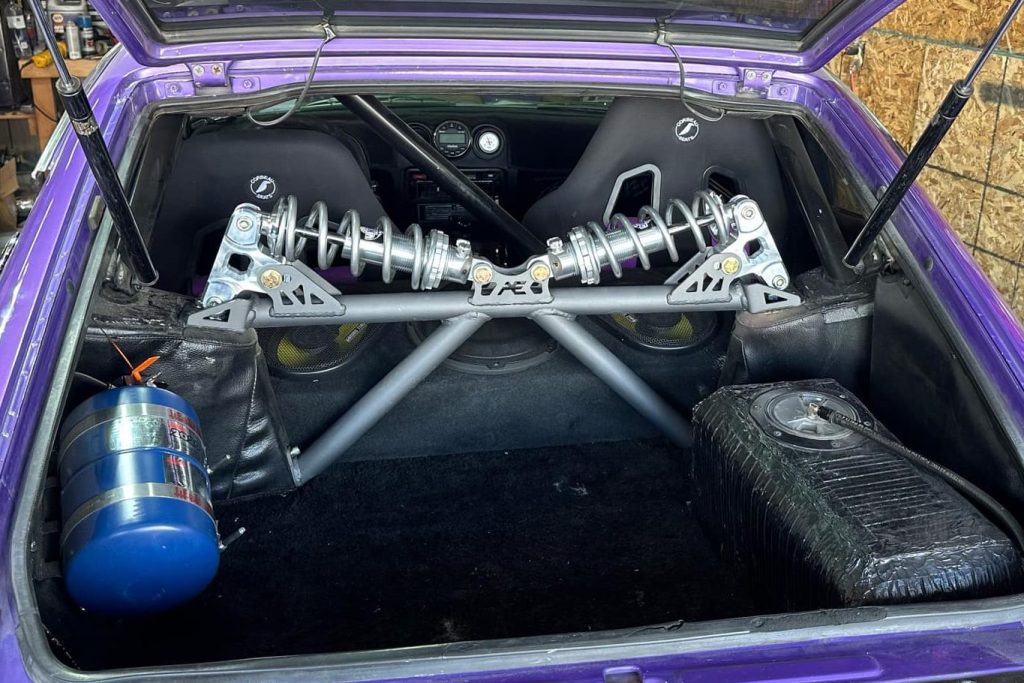
That is where Apex Engineered fits into the final chapter of the story. By developing modern suspension and steering solutions for classic platforms like the S30, S130, Z31, 510-1600, and 310/311 Roadster, Apex Engineered is helping older chassis move into the future alongside their modern counterparts. The aim is not to rewrite the history of these cars. It is to preserve their relevance by giving them the geometry, adjustment, and component quality needed to keep performing in a world that has not stood still.


Sources:
